
Take Notes
Info
 In college and in life, you'll need to take notes. The list of software purporting to do this job for you using your laptop, tablet, or phone are endless, but no matter how many stars they have, nothing beats a simple pen and journal. And likewise, nothing beats making your own.
Though it may seem trivial, you will be surprised by the effort it takes to create these items. It's a journey through which you'll gain first hand experience in:
- paper making
- book binding
- leather working
- graphic design
- laser cutting
- hand and power tools
- wood and metal lathe use
- wood and metal finishing
- ink making
In this one week camp you'll make your own pen and journal from as close to the basics as we can get. You'll venture with us to source the necessary materials from a nearby nature center, learning about local trees along the way and the role these plants play in our papers and pens. We'll visit a sawmill where we'll learn about lumber; it's structure, grain, and hardness, and we'll acquire the wood we need for our pens. We'll visit a leather company to understand the source and destiny of modern hides, and to acquire the covers of our journals. You'll use a wood lathe to turn the lumber you found into an ergonomic pen, and a metal lathe to make the metal bushings, tips, and mechanisms that let it function.
What you'll leave with is a pen and journal, made by you, engraved with your own design, and ready to be put to use in your first year at college. But more valuable than anything will be the experience you take away.
This camp session is 5 days and 6 nights long and is led by two highly experienced maker educators at Vector Space. An RA will accompany students before and after Vector Space hours, and a local guide will lead students through cultural experiences at various Lynchburg events and locations.
General Schedule
Students arrive on campus on Sunday, July 26th. Check-in begins at 2pm, and a welcome dinner will take place that evening, where students will meet their fellow campers, RA, instructors, and cultural guide. For Monday through Friday, the general schedule is as follows.
7:00 - 8:30 Wake-Up and Breakfast
8:45 - 9:00 Bus to Vector Space
9:00 - 11:45 Vector Space program
11:45 - 12:30 Lunch and guest speaker
12:30 - 4:30 Vector Space program
4:30 - 4:45 Return to campus
4:45 - 6:00 Relaxation & Personal Time
6:00 - 7:00 Dinner
7:00 - 9:00 Evening Activity
9:00 - 9:30 Final Check-in
9:30 - 7:00 Room Curfew
Students will have an opportunity to present their work to the public at the conclusion of camp. Check out is Saturday morning after breakfast.
Eligibility
This camp is for rising college freshmen throughout the country.
Some experience with basic hand tools (hammer, drill, screwdrivers, etc) is expected, but far more important is your work ethic and ability to work independently. Prior technical knowledge is not expected or required; instructors will lead students through lessons to be followed by independant application of skills learned.
Registration
The tuition fee for this program covers housing, all meals, the course, supplies, and cultural activities from Sunday evening through Saturday morning. Airfare, transportation to and from the airport, meals purchased outside the program, and personal shopping are not included in this cost.
Student registration is processed on a first-come, first-served basis and guaranteed upon final payment. Payments are refundable until April 1st, 2020, after which they become non-refundable.
Tuition is $1100 through March 31st. Price increases to $1250 on April 1st. Payments are made via credit card under the Registration tab.
Learn More
We have written a high-level post about our Summer 2020 Maker Camps here. This post includes details about the camp host, Vector Space, as well as our boarding partner and the city of Lynchburg, VA.
For details about curriculum and logistics (room and board, transporation, etc.) see our Makerveristy FAQ page.
For a deep dive into our educational philosophy and beliefs, click here.
Our Sponsor
This program is generously funded by Cognizant's Making the Future program, which seeks to inspire young learners to pursue science, technology, engineering and math disciplines by creating fun, hands-on learning opportunities.

Instructors
Corey Lanning

Corey started machining in high school, and has been doing so ever since. After graduation he worked in various machine shops earning his Journeyman’s card, and is now supervisor of Framatome's machine shop where he makes parts for the nuclear industry.
His professional role includes training new machinists, and he enjoys seeing others excel and hopes to inspire future generations to have confidence and belief in their abilities. He believes that every mistake is an opportunity to learn, and has seen first hand the effectiveness of hands-on learning.
In his free time, Corey brings his skill home, fabricating decorations for his home, machining parts for antique restorations, and even turning he and his wife's titanium wedding bands. He also enjoys working on trucks, the outdoors, hiking, fishing, hunting, floating the river in the summer time, and serving as a volunteer fire fighter.
Eric Carlson
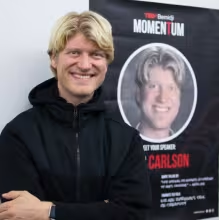
Eric Carlson is a full-time K-12 art and design teacher at Kelliher Public School. He runs a fabrication arts lab (Fab Lab makerspace) within the school, operating 3D printers, a CNC laser cutter, a CNC plasma cutter, a mill, virtual reality machine, and a vinyl cutter. The Kelliher School Fab Lab won the Profiles in Excellence award in 2017 from the Minnesota Rural Education Association (MREA) and Eric was a semifinalist for Teacher of the Year in Minnesota in 2018. Eric has a passion for the intersection of art and technology, especially when it fosters students’ innate creativity. He is a teaching coach at Kelliher and uses the Authentic Intellectual Work (AIW) framework, guiding instructors on experiential learning best practices and higher order thinking outcomes.
In October 2018, Eric gave a TEDx talk in Bemidji Minnesota about makerspaces in the classroom that can be watched online, and he is currently working on writing a pair of books about his program: "The Maker Mindset" on the pedagogy and philosophy of making, and "The Maker Toolkit" that outlines his curriculum and lesson plans that he uses in the classroom.