
FRC Robotics
Info

FIRST Robotics is the ultimate sport of the mind.
In 2025, Lynchburg launched a new educational robotics initiative. Under strict rules and limited time and resources, teams of high school students are challenged to build industrial-size robots to play a difficult field game in alliance with other teams, while also fundraising to meet their goals, designing a team “brand,” and advancing respect and appreciation for STEM within the local community.
Lynchburg's FIRST Robotics Competition (FRC) team is comprised of 14 high school students representing nine different schools in the region. Hosted at Vector Space, the team meets January through March to design, build, iterate, and then compete around the state with peers in Virginia, DC, and Maryland. From engineering concepts and manufacturing knowledge to leadership and business skills, students emerge from this program ready to tackle real world problems with critical thinking skills.

"The Vector Space program was an incredible opportunity for my son. Although it could be challenging at times, especially given his busy schedule with school, tennis, philanthropy, and more, he truly enjoyed working with everyone to build the robot and compete. We are forever grateful for the generous scholarship that made this opportunity possible. The only reason he would not attend again is that he is a senior and will be heading off to Caltech in the fall. I believe that being a part of Vector Space provided him with valuable hands-on experience, which Caltech appreciated when reviewing his application and likely contributed to his acceptance. I wish the Vector Space Robotics team all the best for future years. You are making a positive impact on young minds and helping guide them toward becoming future robotic inventors."
- Erica Martin, Parent of Vector Space Participant
Overview
In the FIRST Robotics Competition, teams of high school students design, program, and build industrial-sized robots to play an action-packed game, released each year in January. They compete on a themed field as part of a three-team alliance in the spirit of Coopertition®. In 360-degree learning guided by adult mentors, each FIRST® Robotics Competition team also creates a team identity, raises funds to meet its goals, and advances appreciation for STEM in its community.
Schedule
The FRC program is divided into three seasons:
- Pre-Season: Summer enrichment and training; sponsor visits. Roughly 8-10 hours per month.
- Build Season: 8 weeks of robot building madness. 16 hours per week.
- Competition Season: 6 weeks of continued practice, plus 3 weekends of travel to competitions (Richmond, Blacksburg, NOVA).
- Post Season: 4-6 irregularly spaced community engagement events.
Students are expected to attend at least 75% of meetings for each season.

Eligibility
There will be a maximum of 15 students selected for the FRC team. To be eligible, all students must be in grades 9-12 (ages 14 to 18). Students from any area public, private, or home school are eligible.
The registration fee is $500, including participation in a Fall pre-season event. Scholarships are available based on need. Registration covers all team expenses during build season. New students are expected to room with family for their first season of competition. (In subsequent seasons, returning students may stay with teammates at competition and these expenses are covered.)

Additional Information
- We have compiled a list of Frequently Asked Questions to help your family decide if FRC is a good fit for you.
- Check out the team's website for more pictures and info about previous seasons.
- The Team Handbook provides greater detail about team philosophy, structure, and expectations.
- Watch this RoboLeague documentary to get an idea of what it's like to compete in the exciting world of FRC Robotics.
Sponsors
Our sponsors and partners make this program possible, growing STEM appreciation and experience in Lynchburg.


Instructors
Adam Spontarelli
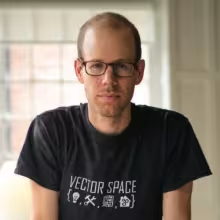
Adam began his career as a Mechanical Engineer in the Nuclear Industry, modeling the flow of fluid and heat through pipes and debris, around baffles and impellers, across differing liquids, gasses, and solids. If the laws of Thermodynamics seemed to misbehave and joules of energy went missing, Adam helped find them.
After nearly a decade in the field, he left his desk job to pursue his passion for science, engineering, and making by founding Vector Space. Adam has built coffee roasters, drones, thermally conductive LED boards, arcade machines, childrens' bikes, robotic painting pianos, smart thermostats, and everything in between. He's fascinated by the way things works, and the more technical it gets, the better.
The only thing he enjoys as much as making things is teaching others to make things. As the Director of Education, Adam is responsible for crafting educational programming that excites and engages students. He incorporates the compelling work of Makiguchi, Dewey, and Papert into his teaching methods, placing experiential learning at the forefront of his efforts. Adam has led students to build their own quadcopter, launch capsules into space, race RC cars at 60 mph, build giant flip books, custom bicycles, skateboards, autonomous boats, and so much more. His programs have been nationally recognized by the Nation of Makers and shared with the maker education community through Maker Ed. Adam is always coming up with new ideas and looking forward to the next adventure.
Andrew Burks
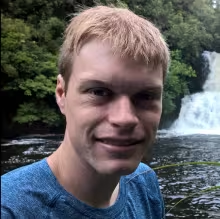
Andrew has a passion for robotics and machinery that started with Legos and FIRST robotics. It grew during his time at Carnegie Mellon through his involvement with the Robotics Club and Robotics Institute. After graduation, the passion was applied in the development of automated industrial equipment at SpaceX. After nearly 10 years of working in Los Angeles Andrew moved back home to Virginia where he works as an independent consultant for companies that need help tackling large, interdisciplinary, technical, automation problems.
Elise Spontarelli

Elise loves vectors. She's made an entrepreneurial career rendering lines, arcs, and polygons, and since cofounding Vector Space, the addiction has only gotten worse. You'll often find Elise giving her designs life by vinyl cutting, laser engraving, and silk screening. When she's not enthralled by graphics, you'll find her in the wood shop making toys and home decor.
Elise is also a strong advocate of the maker movement, and Vector Space's fearless leader.
Liberty IMPACT Club
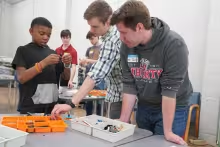
Liberty Engineering students and members of the IMPACT Club on campus will provide mentorship for the FRC team. IMPACT stands for “Inspiring Minds to Pursue Aspirations in Careers and Technology.” The club is composed of computer science, as well as computer, mechanical, and electrical engineering students. Mentors include former teammates from FRC teams 1519 and 8724 based in New Hampshire.
Miguel Gonzalez
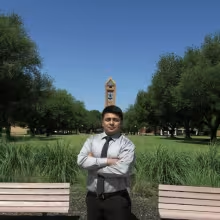
Miguel is originally from Houston, TX, however he's working on making Lynchburg his new home. His favorite machines/tools in the metal shop are the cnc plasma, TIG welders and the bandsaw. Miguel is the Metal Shop Captain at Vector Space, and works as a Welding Engineer at BWXT. Outside of the metal shop he enjoys 3D printing and a fun fact is that he's fully fluent in Spanish.
Nathan Wyand
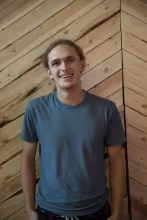
Nathan self describes as "a wild software entwickler building web apps in Lynchburg, Virginia." He is a member at Vector Space where he helps with networking and computer projects. Nathan works at CloudFit Software, and is passionate about smart community development and open source everything. In 2024 he completed the Lynchburg Citizens Academy, and has made more than 150 contributions on GitHub this year.
Nick Lonce
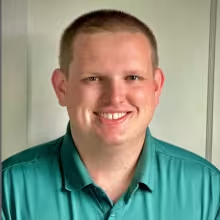
Nick works as a Tooling Engineer at Framatome in Lynchburg. Previously, he interned at Andritz Hydro in Charlotte, NC, and has a BE in Electrical Engineering from UNC - Charlotte. Nick is a member at Vector Space and participates as a mentor for our Engineering Mentoring program, working along high school students to introduce engineering principals and practical applications.