MIG Welding User Guide: Difference between revisions
Jump to navigation
Jump to search
Aspontarelli (talk | contribs) |
|||
| (24 intermediate revisions by 2 users not shown) | |||
| Line 9: | Line 9: | ||
'''Procedure Number''' | '''Procedure Number''' | ||
UG 130-03, Rev. | UG 130-03, Rev. 2 | ||
|width="33%"| | |width="33%"| | ||
'''Date''' | '''Date''' | ||
8/17/2022 | |||
|} | |} | ||
= GENERAL = | = GENERAL = | ||
The | The MIG welder is used for fusing steel and aluminum. We have Lincoln 350MP MIG welders. | ||
[[File:Lincoln 350MP.jpg|thumb]] | |||
= SAFETY = | = SAFETY = | ||
* | * Wear an approved welding helmet fitted with a proper shade of filter lenses to protect your face and eyes when welding or watching. | ||
* Wear approved welding gloves and jacket. | |||
* Wear approved | * Wear protective clothing made from durable, flame-resistant material (leather, heavy cotton, or wool) and foot protection. | ||
* Wear | |||
* Before operating equipment, remove tie, rings, watches and other jewelry, and roll sleeves up past the elbows. Remove all loose clothing and confine long hair. | * Before operating equipment, remove tie, rings, watches and other jewelry, and roll sleeves up past the elbows. Remove all loose clothing and confine long hair. | ||
* Closed toe shoes are required when working in a shop area. | * Closed toe shoes are required when working in a shop area. | ||
* Turn off all equipment when not in use. | * Turn off all equipment when not in use. | ||
| Line 37: | Line 35: | ||
* Do not drape cables over your body. | * Do not drape cables over your body. | ||
* Clamp work cable with good metal-to-metal contact to workpiece or worktable as near the weld as practical. | * Clamp work cable with good metal-to-metal contact to workpiece or worktable as near the weld as practical. | ||
* Do not connect more than one electrode or work cable to any single weld output terminal. | * Do not connect more than one electrode or work cable to any single weld output terminal. | ||
* Do not touch hot parts bare handed. | * Do not touch hot parts bare handed. | ||
* Allow cooling period before working on gun or torch. | * Allow cooling period before working on gun or torch. | ||
* Keep your head out of the fumes. Do not breathe the fumes. Welding produces fumes and gases. Breathing these fumes and gases can be hazardous to your health. | * Keep your head out of the fumes. Do not breathe the fumes. Welding produces fumes and gases. Breathing these fumes and gases can be hazardous to your health. | ||
* Do not weld on coated metals, such as galvanized, lead, or cadmium plated steel, unless the coating is removed from the weld area, the area is well ventilated, and while wearing an air-supplied respirator. The coatings and any metals containing these elements can give off toxic fumes if welded. | * Do not weld on coated metals, such as galvanized, lead, or cadmium plated steel, unless the coating is removed from the weld area, the area is well ventilated, and while wearing an air-supplied respirator. The coatings and any metals containing these elements can give off toxic fumes if welded. | ||
* Arc rays from the welding process produce intense visible and invisible (ultraviolet and infrared) rays that can burn eyes and skin. Sparks fly off from the weld | * Arc rays from the welding process produce intense visible and invisible (ultraviolet and infrared) rays that can burn eyes and skin. Sparks fly off from the weld. | ||
* Use protective screens or barriers to protect others from flash, glare and sparks; warn others not to watch the arc. | |||
* Use protective screens or barriers to protect others from flash, glare and sparks; warn others not to watch the arc | |||
= REFERENCE = | = REFERENCE = | ||
* | * Millermatic 211 Manual (https://www.millerwelds.com/files/owners-manuals/o239988d_mil.pdf) | ||
* MIG welding basics video (https://www.youtube.com/watch?v=v62lm7FGhNc) | |||
* | * [[:File:350mp_manual.pdf| Lincoln 350MP User Manual ]] | ||
* https:// | * MIG welding settings chart (https://weldguru.com/wp-content/uploads/wire-selection-settings-chart-large.jpg) | ||
* | * | ||
= PROCEDURE = | = PROCEDURE = | ||
# Power on welder. | |||
# Open MIG gas bottle and ensure correct flow rate at the regulator. | |||
# Set wire speed to Automatic for 0.030" wire, as this is the wire diameter that should be loaded. | |||
# Set voltage dial according to the material thickness being welded. | |||
# Connect ground clamp to workpiece or work surface. | |||
# Ensure proper PPE is in use and safe surroundings. | |||
# Weld | |||
# When finished, store welding cables properly | |||
# Turn off welder | |||
# Close gas bottle | |||
= TROUBLESHOOTING = | |||
[[File:8-8 MIG Troubleshooting − Excessive Spatter.png]] | |||
[[File:8-9 MIG Troubleshooting − Porosity.png]] | |||
[[File:8-10 MIG Troubleshooting − Excessive Penetration.png]] | |||
[[File:8-11 MIG Troubleshooting − Lack Of Penetration.png]] | |||
[[File:8-12 MIG Troubleshooting − Incomplete Fusion.png]] | |||
[[File:8-13 - 14 MIG Troubleshooting − Burn-Through and Waviness.png]] | |||
[[File:8-15 MIG Troubleshooting − Distortion.png]] | |||
'''END OF THE PROCEDURE''' | '''END OF THE PROCEDURE''' | ||
Latest revision as of 08:09, 1 May 2025
|
Shop Area: Metal Shop Tool: MIG Welding Requires in-person training: Yes |
Procedure Number UG 130-03, Rev. 2 |
Date 8/17/2022 |
GENERAL
The MIG welder is used for fusing steel and aluminum. We have Lincoln 350MP MIG welders.

SAFETY
- Wear an approved welding helmet fitted with a proper shade of filter lenses to protect your face and eyes when welding or watching.
- Wear approved welding gloves and jacket.
- Wear protective clothing made from durable, flame-resistant material (leather, heavy cotton, or wool) and foot protection.
- Before operating equipment, remove tie, rings, watches and other jewelry, and roll sleeves up past the elbows. Remove all loose clothing and confine long hair.
- Closed toe shoes are required when working in a shop area.
- Turn off all equipment when not in use.
- Do not use worn, damaged, undersized, or poorly spliced cables.
- Do not drape cables over your body.
- Clamp work cable with good metal-to-metal contact to workpiece or worktable as near the weld as practical.
- Do not connect more than one electrode or work cable to any single weld output terminal.
- Do not touch hot parts bare handed.
- Allow cooling period before working on gun or torch.
- Keep your head out of the fumes. Do not breathe the fumes. Welding produces fumes and gases. Breathing these fumes and gases can be hazardous to your health.
- Do not weld on coated metals, such as galvanized, lead, or cadmium plated steel, unless the coating is removed from the weld area, the area is well ventilated, and while wearing an air-supplied respirator. The coatings and any metals containing these elements can give off toxic fumes if welded.
- Arc rays from the welding process produce intense visible and invisible (ultraviolet and infrared) rays that can burn eyes and skin. Sparks fly off from the weld.
- Use protective screens or barriers to protect others from flash, glare and sparks; warn others not to watch the arc.
REFERENCE
- Millermatic 211 Manual (https://www.millerwelds.com/files/owners-manuals/o239988d_mil.pdf)
- MIG welding basics video (https://www.youtube.com/watch?v=v62lm7FGhNc)
- Lincoln 350MP User Manual
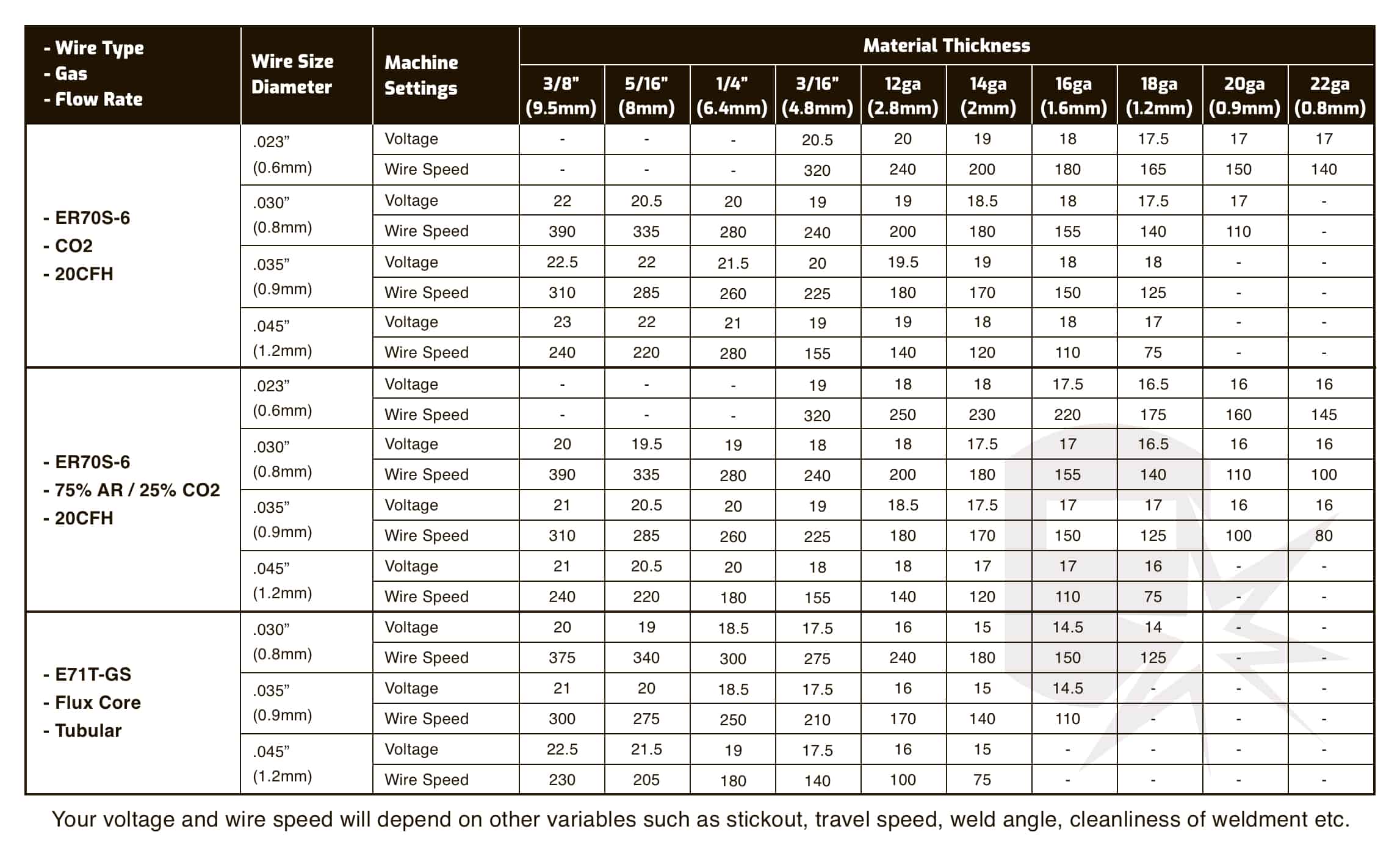
- MIG welding settings chart (https://weldguru.com/wp-content/uploads/wire-selection-settings-chart-large.jpg)
PROCEDURE
- Power on welder.
- Open MIG gas bottle and ensure correct flow rate at the regulator.
- Set wire speed to Automatic for 0.030" wire, as this is the wire diameter that should be loaded.
- Set voltage dial according to the material thickness being welded.
- Connect ground clamp to workpiece or work surface.
- Ensure proper PPE is in use and safe surroundings.
- Weld
- When finished, store welding cables properly
- Turn off welder
- Close gas bottle
TROUBLESHOOTING


END OF THE PROCEDURE